

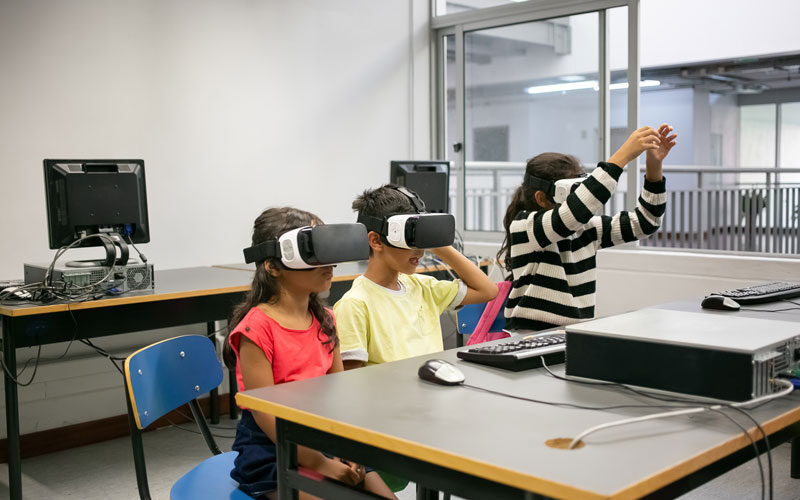
What is VR Class?
VR classroom is a Virtual Reality classroom. In this class, Students interact with their curriculum in 3D. Instead of reading books and doing classwork, students learn and interact visually by using VR headsets or applications. Furthermore, teachers can also use this tool pointing out students’ more information. Teachers can also use this tool to highlight or mark important sections and show these to their students more effectively by showing student’s personal points or specific positions. VR glasses were raised suddenly right after investing in technologies that are related to VR techniques. For example, VR visualization software or AR visualization software is one of the fuels that allows a VR experience. To use VR in the classroom, teachers must train in VR experience. Teachers should understand and know well about this tool to use VR technologies in class. Also, schools should have enough money to place VR tools. For example, VR headsets like Meta Quest 2 cost under 100 dollars. But this is not everything, wearable VR glasses and storage, smartphones are also needed to make an VR- friendly environment. Also locations are important. Schools that are located outside of the city or schools that are hard to connect to Wi-Fi easily can struggle with VR classrooms. Also, schools that have temporal problems can be hard to use VR technologies. (Mattoo, S. (2025)
Pros
One of the main benefits of the VR Classes is that Students who have disabilities allow many accessibility. With a setting of a traditional classroom, students can be challenged for social or physical disabilities, but VR classes allow an adaptable and friendly environment for those students. (Wilkins, S.(2024). Another crucial benefit of VR Classes is that they can save time, money, and the environment. Students can interact with other places on Earth by using VR-based activities, which allows schools to save money to go to specific places. Also, students don’t need to take any transportation to go to other places on Earth if they use VR technologies, which saves time to get to those places. (Barnard, D.(2023)
Cons
There are many problems with VR Classes. One of them is High costs and Resource requirements. Most schools are not able to pay money to use VR Class in their school. Because it’s not just finished if those schools buy VR tools, they need teachers to train, also they need technical support to help them when they have a problem. In these ways, schools must weigh those costs to get the potential benefits. Schools should be concerned about accessibility issues, because not all students may be able to use VR Classes. Students who have motion sickness, visual or auditory impairments, or other health concerns cannot use VR Classes. Those Students and normal students will have a big difference. This can make a divide between students who can learn by using VR activities and students who cannot participate in VR Classes. (Wilkins, S.(2024)
Lot of educators have different opinions about VR Classes, because it can be either good or bad. Schools or academies that try to use VR Classes in their curriculum, they need to understand the benefits and throwbacks of VR Classes to create sure to get high potential benefits.
Reference
Mattoo, S. (2025). What is a VR Classroom? Explanation and Top Software in 2025. [online] G2. Available at: https://www.g2.com/articles/vr-classroom [Accessed 24 Jun. 2025].
Wilkins, S. (2024). What Are the Pros and Cons of Bringing Virtual Reality into K-12 Classrooms? [online] Teach Away. Available at: https://www.teachaway.com/recruitment/blog/pros-and-cons-virtual-reality-k12-classrooms .
Barnard, D. (2023). Benefits of VR training. [online] virtualspeech.com. Available at: https://virtualspeech.com/blog/benefits-of-vr-training .
